Tables and figures behind Mercury 2.5: a cheap diffusion LLM with a hard ceiling. A section number (§) refers to the project’s design log.
The findings, by list
Likely from diffusion decoding or from how Inception serves Mercury:
| Finding |
What it means |
Number |
Source |
| A call is mostly the wait for the first token |
Decoding is fast, but each call waits on a round trip before any text arrives, so the number of calls sets a run's time |
generation 0.16 s of a 1.46 s call |
§1, §7 |
| Stalls hide behind keep-alives |
Some calls never start, but the router sends a "still processing" signal at once, so a first-byte timeout never fires |
330 of 50,924 calls silent until a 504 at ~120 s; median first content 1.15 s, p99 11.7 s |
§69 |
| Every call ran at temperature 1.0 |
The harness asked for low, near-deterministic sampling; the provider silently replaced it with its most random setting |
asked for 0.0-0.3; Inception resets anything outside 0.5-1.0 |
§85 |
| Temperature 0.5, tested |
A lower setting the provider does accept, tried against the 1.0 every run had used |
32 runs a side, not distinguishable, leaned worse |
§82.2 |
| Hidden reasoning |
Mercury thinks in tokens the API never returns; only their count comes back |
~96% of output tokens (95.9% over 93,312 calls) |
§53, §82.1 |
| More effort, fewer calls |
Lowering the executor's reasoning effort did not save reasoning; it spread it over more calls |
12.8 calls a run at high; 14.9, 18.4, 18.3 at medium, low, none |
§53.2 |
| Runaway reasoning |
A rare call reasons for over a minute before a short answer; an output cap stops it |
~1% of SciCode calls, ~62,000 hidden tokens, 77 s; a 16k cap cut model time 30% |
§95, §95.1 |
| Intermittent prompt cache |
The provider's cache of the repeated start of each prompt engaged on some calls and not others |
20% (SciCode night) to 67% (game project) of calls cached nothing |
§95.2 |
| Provider slowdown |
The same prompts got slower over the month with no change on my side |
first token 28-45% later, decode ~1,640 to ~1,310 tokens/s over September |
§95, §114 |
Could come from any cheap model:
| Finding |
What it means |
Number |
Source |
| Optional tools unused |
Tools offered for particular jobs, such as structural renames, were almost never called |
4 calls in ~3,100 offers over 3,915 runs |
§62 |
| Reference notes unused |
The tool for reading the reference notes written for the model was called once, while its catalogue rode on every call |
1 read in 59,338 executor calls, ~420 tokens a call |
§113 |
| Rules decay over a step |
An instruction in the system prompt is followed early in a step and ignored a few turns later |
batching 6.0% of replies on turns 0-1, 1.5%, 0.8%, 1.2% later |
§82 |
| Reminder after the last message |
Repeating the rule after the latest message, on every call, kept it followed |
execute replies −21% (fixtures), −24% (django), calls −11% (django) |
§106.2, §107.3 |
| Tool calls fail on arguments |
The model always named a real tool; failures were arguments that did not parse |
plan call unparsable in 12% of runs; strict schemas 0 of 432 vs 9 of 524 |
§63, §63.1 |
| Wrong bug reports believed |
On tasks whose bug report is false, the model changes the correct code instead of saying so |
misreport-discount, misreport-documented honest 0 of 3 each |
§54.3, §96.4 |
| Codex CLI |
Inside Codex, Mercury printed its answer in the chat and never wrote the solution file |
printed the code and wrote no file in 11 of 15 SciCode problems |
§109.5 |
Settings that worked with Mercury
| Setting |
What it controls |
What happened without it |
Use |
| Temperature |
How random the sampling is |
reset to 1.0 outside 0.5-1.0 |
send 0.5-1.0, or nothing |
| Reasoning effort |
How much hidden reasoning the model does before answering |
lower effort added calls |
high for the executor |
max_tokens |
The most output tokens, hidden reasoning included, a call may produce |
rare calls reasoned for over a minute |
16,000 |
| Strict tool schemas |
Whether the provider enforces each tool's argument format exactly |
12% of plan calls unparsable |
on for every tool |
tool_choice |
Whether a call must end in a tool call or may answer in plain text |
32 of 188 forced final calls came back as prose (§74) |
require the tool when a call must end in one |
| Where a rule sits |
Where in the prompt an instruction is placed |
system-prompt rules decayed |
repeat after the last message |
| A cut on silent calls |
How long a call may produce nothing before the harness cancels and re-sends it |
stalls ran to ~120 s |
30 s with no content |
The release candidate’s final sweep
Every run had review on, which is now off by default (§124.10).
| Each suite beside a same-day control or the task's own history |
| Seeded fixtures, 16 tasks × 3 |
48 |
accuracy 0.917; 38 perfect; 41 honest |
each task's own history |
| SciCode, 15 problems × 3, search off |
45 |
23/45 solved (7.7 of 15 a round) |
earlier search-off rounds: 7.3 a round |
| django, 10 tasks × 3 |
30 |
15/30 |
mini-swe-agent, same model, same day: 18/30 |
| GAIA, 127 questions |
127 |
59/127 |
the 30 Sep harness, same day and search: 61/127 |
The same model in other agents, and other models in this harness
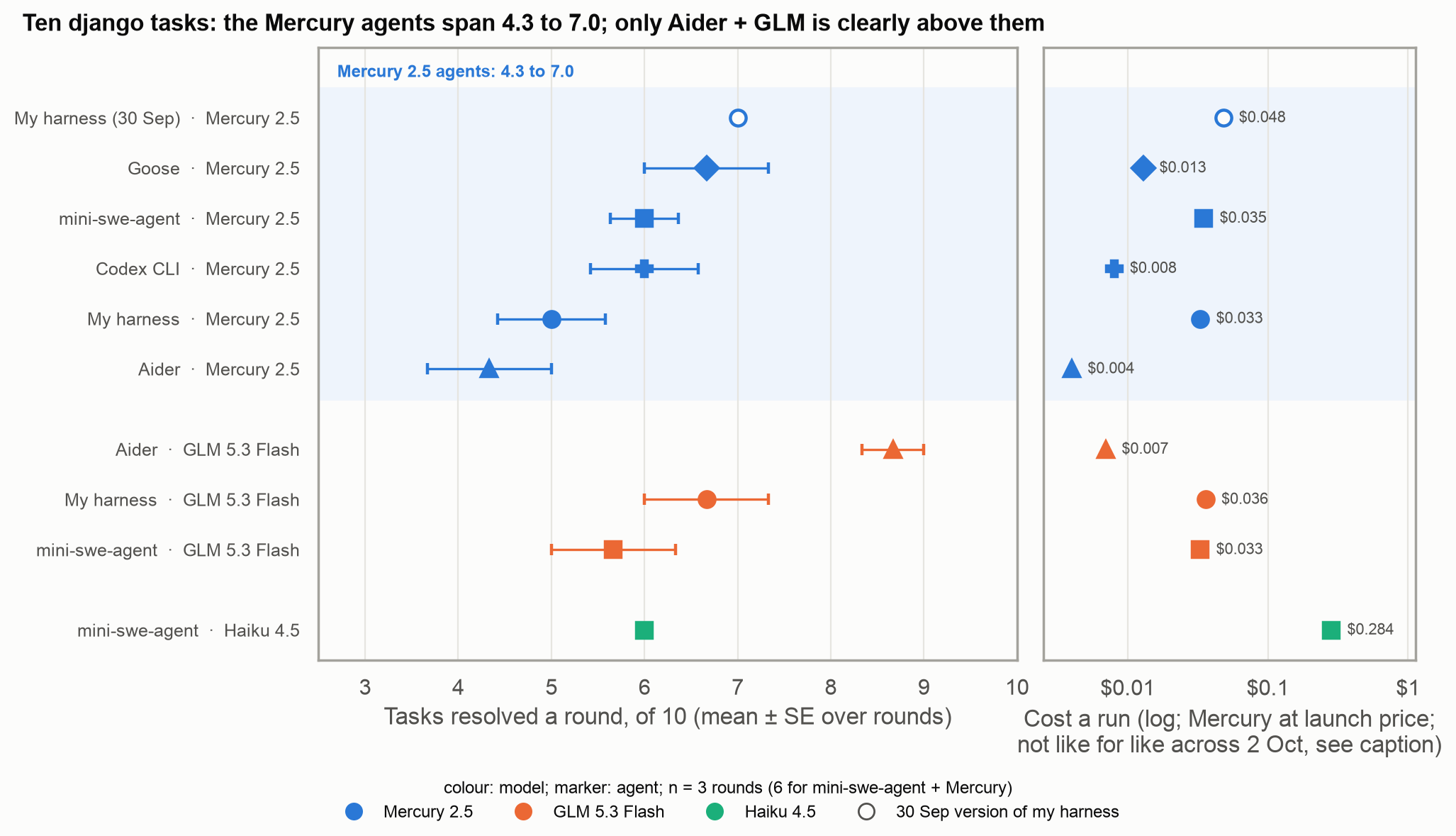
| Mean ± SE over rounds; a dash: not run on that suite |
| Mercury 2.5 |
| My harness (30 Sep) |
7.0 ± 0.0 of 10 |
$0.048 |
– |
– |
| Goose |
6.7 ± 0.7 of 10 |
$0.013 |
7.5 ± 1.5 of 15 |
$0.021 |
| Codex CLI |
6.0 ± 0.6 of 10 |
$0.008 |
4.0 ± 0.0 of 15 |
$0.018 |
| mini-swe-agent |
6.0 ± 0.4 of 10 |
$0.035 |
7.7 ± 0.3 of 15 |
$0.034 |
| My harness |
5.0 ± 0.6 of 10 |
$0.033 |
7.7 ± 0.9 of 15 |
$0.11 |
| Aider |
4.3 ± 0.7 of 10 |
$0.004 |
7.5 ± 0.5 of 15 |
$0.011 |
| GLM 5.3 Flash |
| Aider |
8.7 ± 0.3 of 10 |
$0.007 |
5.0 ± 0.0 of 15 |
$0.012 |
| My harness |
6.7 ± 0.7 of 10 |
$0.036 |
10.0 ± 0.0 of 15 |
$0.405 |
| mini-swe-agent |
5.7 ± 0.7 of 10 |
$0.033 |
– |
– |
| My harness, GLM plans |
– |
– |
8.5 ± 1.5 of 15 |
$0.255 |
| Haiku 4.5 |
| mini-swe-agent |
6.0 ± 0.0 of 10 |
$0.284 |
– |
– |
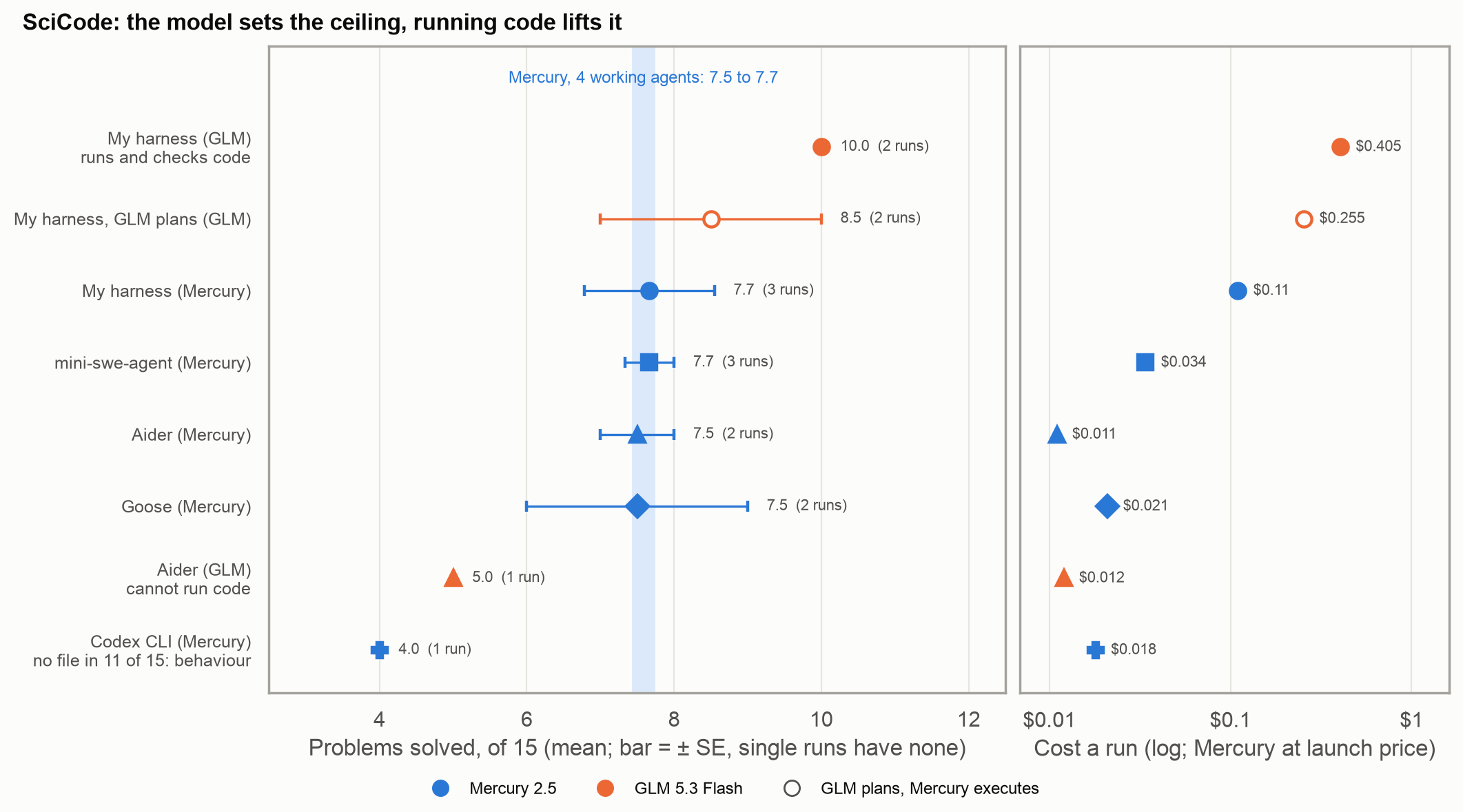
Mean ± SE over rounds; a dash means the agent was not run on that suite. Mercury costs are at its launch price, and Goose and Codex are priced with their cached input (§122). Codex’s SciCode score reflects behaviour rather than ability: it printed code and wrote no file in 11 of 15 problems.
django, every configuration
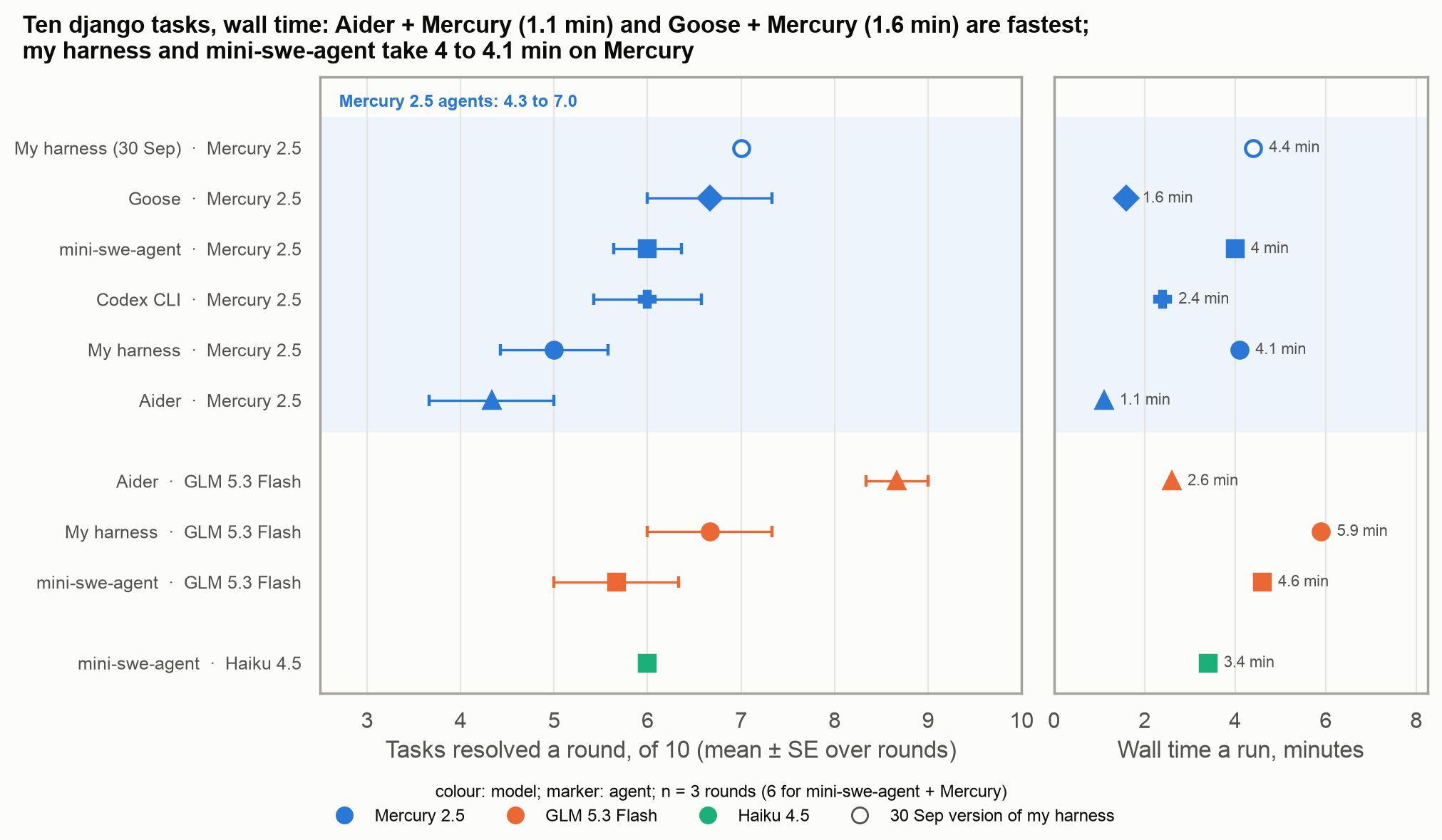
Resolved of 30 (three runs of ten tasks), after §118 voided eleven contaminated wins; the as-scored count is in brackets where it differs. Intervals are 95% bootstrap intervals on the difference in resolve rate against the release harness (15 of 30).
Costs need two caveats (§122). Goose and Codex report their own token counts, priced here at OpenRouter’s list price with cached input at the cached price; at full list price they read $0.060 and $0.044 a django run. And Mercury’s provider cached 5-22% of the harness’s input before about 12:00 UTC on 2 October and 50-72% after, with no harness change. My harness’s rows and the §94 rows ran before that line, Goose, Codex and the GLM rows after it, so costs across the line are not like for like. Every run of my harness in these tables had review on; review is off by default since 6 October (§124.10).
| Resolved of 30 after §118's voids (as scored in brackets) |
| GLM |
| Aider |
26 (27) |
0.007 |
2.6 |
+0.37 [+0.13, +0.57] |
| My harness |
20 |
0.036 |
5.9 |
+0.17 [−0.07, +0.40] |
| mini-swe-agent |
17 (20) |
0.033 |
4.6 |
+0.07 [−0.20, +0.30] |
| Mercury |
| Goose 1.52 |
20 (22) |
0.013 |
1.6 |
+0.17 [−0.07, +0.40] |
| Codex CLI 0.160 |
18 (20) |
0.008 |
2.4 |
+0.10 [−0.13, +0.33] |
| mini-swe-agent 2.4.6 |
18 and 18 (20, 19) |
0.035 |
4.0 |
+0.10 [−0.13, +0.33] |
| My harness, 30 Sep |
21 |
0.048 |
4.4 |
|
| My harness, release |
15 |
0.033 |
4.1 |
|
| Aider |
13 |
0.004 |
1.1 |
|
| GLM, Mercury |
| My harness, GLM plans |
23 (§94), 16 of 26 (§109) |
0.028 |
4.8 |
+0.12 [−0.14, +0.37] |
| Haiku 4.5 |
| mini-swe-agent |
18 |
0.284 |
3.4 |
|
The release against its own 30 Sep version
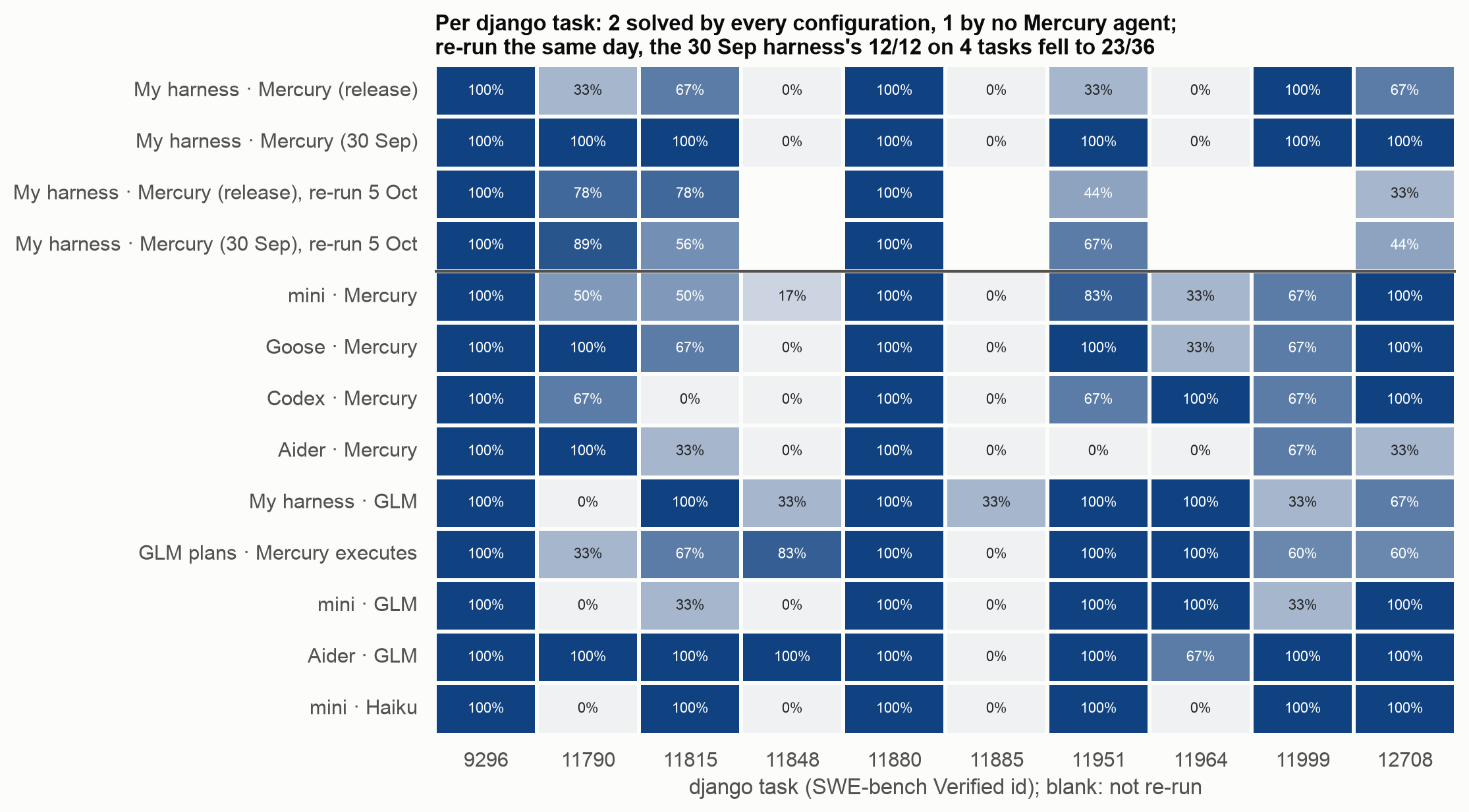
The release resolved 15 of 30 where the 30 Sep version had resolved 21, all of the gap on four tasks. Re-run the same day in isolated workspaces (§120), the two came out level, and the release used about 40 percent fewer calls:
|
Release |
30 Sep harness |
| First rounds, ten tasks |
15/30 (2 Oct) |
21/30 (30 Sep) |
| First rounds, the 4 tasks that differed |
6/12 |
12/12 |
| Same 4 tasks re-run 5 Oct, isolated, same day |
21/36 |
23/36 |
| Calls a run, re-run |
34 |
57 |
| Cost a run, re-run |
$0.0115 |
$0.0179 |
The 30 Sep first rounds were one unusually good set: same provider, same cache state before 2 October, and neither set of rounds read the fix from git history.
SciCode, 15 development problems
Problems solved (every sub-step passing), search off.
| Problems solved, every sub-step passing, search off |
| GLM |
| My harness |
10, 10 |
10.0 |
0.405 |
| Aider (no execution) |
5 |
5.0 |
0.012 |
| Mercury |
| My harness |
6, 8, 9 |
7.7 |
0.110 |
| mini-swe-agent |
8, 7, 8 |
7.7 |
0.034 |
| Aider (no execution) |
8, 7 |
7.5 |
0.011 |
| Goose |
6, 9 |
7.5 |
0.021 |
| Codex CLI |
4 |
4.0 |
0.018 |
How GLM differs as a planner
From §119 and earlier sections; measurements, not pre-registered comparisons.
- django: GLM’s plans name the upstream fix in 51% of runs, Mercury’s in 0%. GLM planning with Mercury executing resolves 11964 5 of 5 (the harness with Mercury picks the wrong file in all 6 runs) and 11848 5 of 6 (no Mercury agent in 12 runs). GLM’s losses on 11999 and 11790 are recalled code colliding with the hidden tests.
- Plans: GLM’s declare ~1.8 times as many tests and are 3-4 times more consistent in step count for the same goal (§42).
- Research: on SciCode, 20 web searches, 53 fetches and 61 skill reads against none for Mercury, which asked 18 “Should I proceed?” questions instead (§77).
- Cost and time: 2-3 times Mercury’s cost on SciCode, about 3 times the time; its planning time is round trips at 5-7 s to first token (§76, §77).