Our paper on the ND70 reference glasses came out in Geostandards and Geoanalytical Research: Moussallam, Towbin, Plank et al. (2024). It describes a set of basaltic glasses with known amounts of water, CO₂, sulfur, chlorine and fluorine, made so that labs can calibrate their instruments over the full range found in nature.
A gap in the calibration data
Much of what we know about volcanic gases comes from tiny glass inclusions trapped in crystals, measured with an ion probe (SIMS). SIMS is a relative method: it only gives concentrations if you calibrate it against glasses whose composition is already known.
The available basaltic standards did not cover the range of real samples. Water calibrations above about 1 wt% were extrapolated, and the CO₂ standards stopped near a few hundred ppm, well below many natural melts. Any measurement outside that range depended on a straight line drawn past the last data point.
Making the glasses
The ND70 series was made to fill that gap. We started from a single basalt, added known amounts of water, CO₂, sulfur, chlorine and fluorine, and melted each mix at 1 to 1.5 GPa in a piston-cylinder press so the gases stayed dissolved. The series spans 0 to 6 wt% water, 0 to 1.6 wt% CO₂, and 0 to 1 wt% sulfur, chlorine and fluorine. Older standards from earlier studies were included so the labs could cross-check them against the new ones.
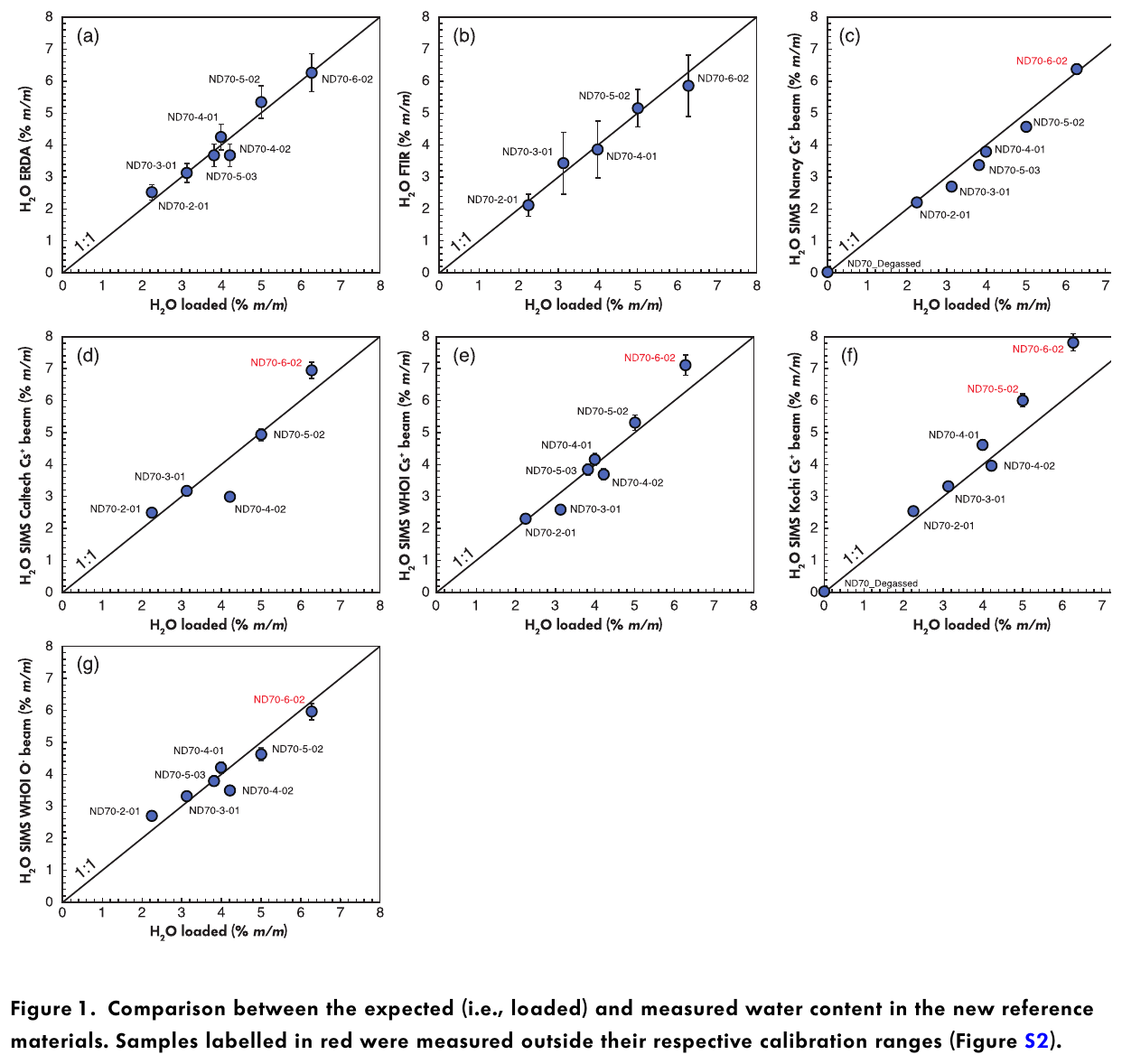
Labs in the US, France and Japan then measured the glasses by several independent methods: elastic recoil detection, nuclear reaction analysis, an elemental analyzer, infrared spectroscopy, electron microprobe, and SIMS at four different ion-probe facilities.
What we found
The amounts we loaded and the amounts measured agree well across methods and labs, so the glasses can serve as reference materials.
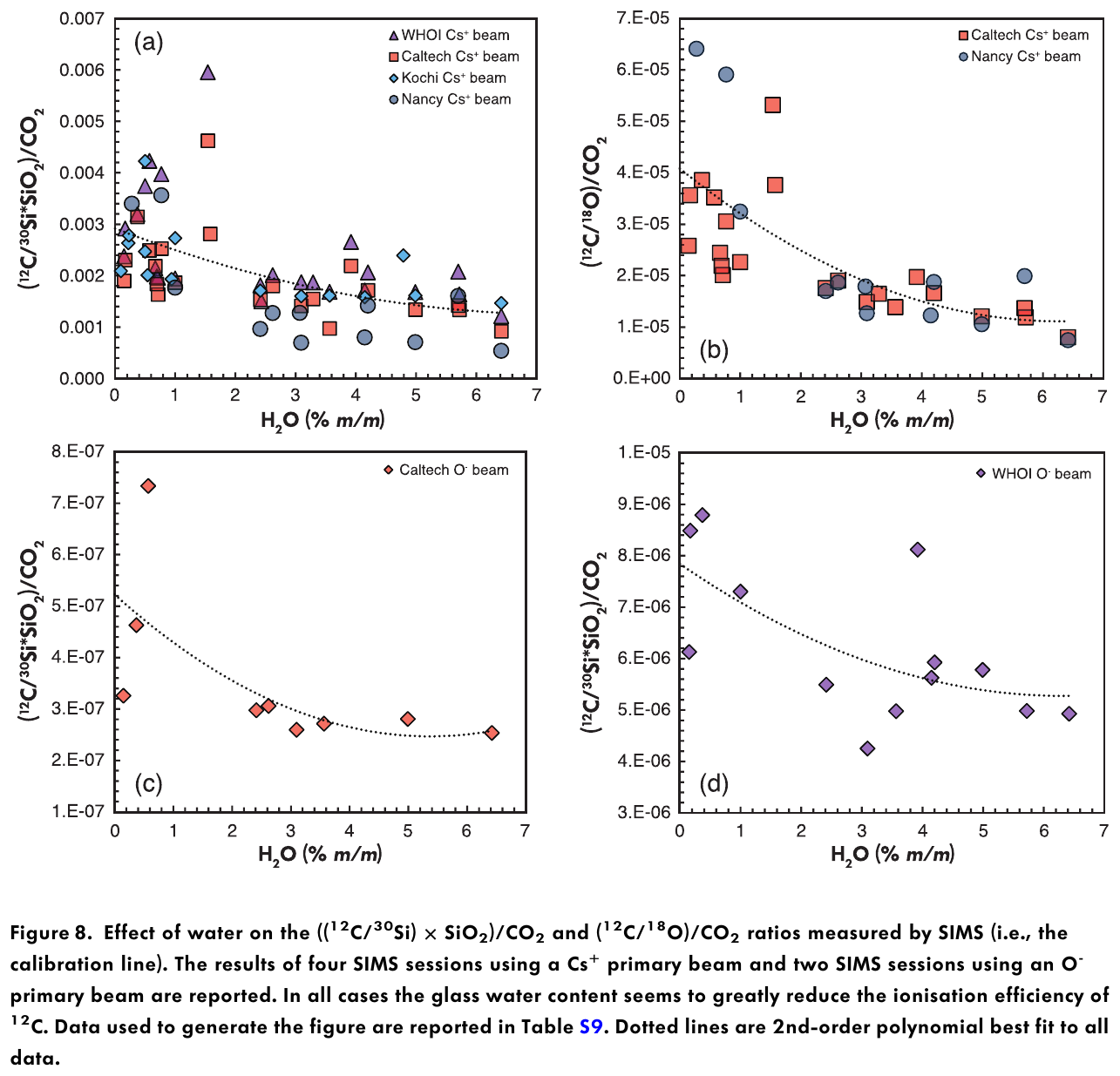
We also found a problem with how SIMS measures carbon. The more water a glass contains, the weaker its carbon signal. Measuring a glass with 4 wt% water against standards with less than 2 wt% water could underestimate its CO₂ two- to three-fold, and the reverse mismatch overestimates it. The fix is to calibrate with standards whose water content matches the samples, which the ND70 series now makes possible.
Where the glasses are now
Pieces of each glass went to ion-probe labs in the US, Europe and Japan. The rest are held at the Smithsonian National Museum of Natural History, where any researcher can borrow them.
I helped start the project after finding gaps in the basaltic glass standards available for calibrating water and CO₂ by SIMS and FTIR. I ran the piston-cylinder experiments at Lamont-Doherty and helped coordinate the analyses across the labs.
Figures reproduced unchanged from Moussallam et al. (2024), Geostandards and Geoanalytical Research 48(3), 637–660, under a CC BY-NC-ND 4.0 license.